

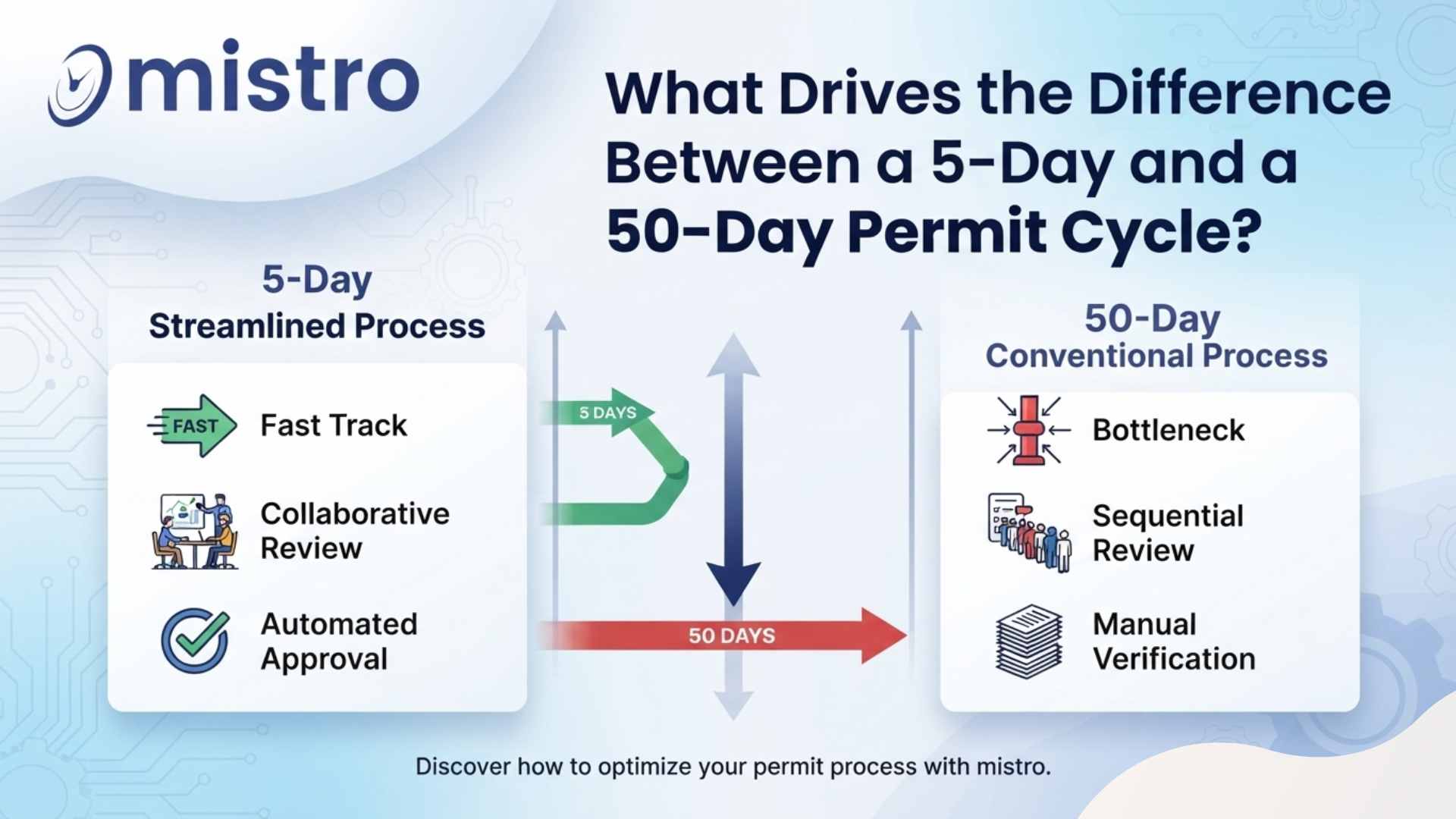
Every electrical contractor who has pulled permits in more than one place knows the feeling. You submit in one county and have a number in hand by the end of week. You submit in what looks like a comparable jurisdiction across the state line and weeks go by. Same scope, same crew, same type of work. Completely different cycle.
The natural assumption is that the spread comes from the jurisdiction. Some offices run lean and move fast. Some are buried in the backlog and move slowly. Pick your zip code and adjust your schedule accordingly.
That assumption is wrong. Or at least, it’s wrong in the way that matters most to you.
After speaking with permit offices across multiple states — small county building departments, mid-size municipal offices, jurisdictions that handle their own review and jurisdictions that outsource it — the same answer came back every time. The permit cycle isn’t mainly determined by which office you’re submitting to. It’s mainly determined by what you submit to them.
“The cycle length is mostly decided before you submit. A complete packet rides the fast path. An incomplete one drops into a back-and-forth loop that no portal status bar will rescue you from.”
That’s the whole blog in two sentences. What follows is why it’s true and what to do about it.
Before We Get Into Speed: The Permit You’re Thinking About May Not Exist
One thing that came up consistently in these conversations is worth surfacing before we talk about cycle times at all.
For commercial electrical work, the permit you’re expecting to pull — a standalone electrical permit issued to your company — frequently isn’t the mechanism. In many jurisdictions, electrical scope is folded into the general contractor’s building permit as a section among others, not issued as a separate trade permit you can track independently. In some states, electrical permitting isn’t even a county or municipal function; it routes to a state agency entirely.
That changes what the electrical permit cycle actually means in your situation. Sometimes you’re waiting on your own permit. Sometimes you’re waiting on a permit the GC pulled, with your scope buried inside it. Sometimes you’re in a queue at a state office that has nothing to do with the local building department at all.
The answer to how long does the electrical permit take depends on who the question is really directed at. Knowing the answer to that before you submit — who actually issues the permit for this project, in this jurisdiction, for this scope — is itself a step that separates contractors who get surprised by cycle times from the ones who don’t.
What Actually Separates a Fast Cycle From a Slow One
With that framing in place: when we asked permit offices what makes one application fly through and a similar one drag, the answer was the same across every office that had a real process to describe.
Completeness of the submission. Not the size of the project. Not the jurisdiction. Not the season. Whether the packet that landed in their queue had everything in it — the right documentation, the correct drawings, the applicant registered in their system — or whether it had gaps.
One mid-size county building department described their process bluntly: if the contractor is registered in their system and the application comes in with the plans and the scope of work attached, it turns around in under 24 hours. If registration is missing, or the plans aren’t attached, or the scope isn’t there — they ask for more information, and the clock is effectively paused until the applicant gets it to them.
Same desk. Same reviewer. Under 24 hours if the packet is clean. Open-ended if it isn’t.
A building official at a separate office said the same thing from the reviewer’s perspective when asked what makes one permit fast and another slow:
“The level of completeness of the permit documents that were submitted — the drawings and things like that — more than anything.”
And the slow path, in that same office’s description, is the whole problem in one line: a perfect application ‘is easy to review,’ but an incomplete one could go back and forth — ‘hey, you didn’t send us this document, send in this document.’
A third office put it as cleanly as it gets: ‘If they’ve submitted everything that’s on the checklist when they submit their application, there is nothing to hold it up.’
Three offices in different states, three different processes, one answer. Completeness.
| The two ways a packet ends up incomplete1. Missing documents. Plans, scope of work, load calculations, site plans — whatever the checklist requires. The specific list varies by jurisdiction and project type, but every office has one. If something on it is absent, you’ll get an email asking for it. That email is the slow-cycle signal.2. Not being registered. Several offices mentioned that contractor registration is a prerequisite for the clock to start — not just a formality to handle later. Showing up in their system as a registered contractor is part of what makes your application “complete” in the first place. |
Where the Time Actually Goes When the Cycle Is Slow
Once you understand the completeness mechanism, the anatomy of a slow cycle makes more sense.
Stop picturing a long line at the electrical reviewer’s desk. That mental model leads you to think the solution is getting into a faster jurisdiction, or timing your submission to avoid a busy season. Those things matter, but they’re secondary.
The slow cycle is mostly dead time. It’s the gap between when the office emails you for a missing document and when you get it back to them. Everything in between — the working days, the weekend if the email arrives Friday, the time it takes your team to locate and assemble the missing piece — is time the application sits. The reviewer isn’t looking at it. Nobody is.
The fast-path timelines we heard, when the packet is clean, are genuinely short:
- Under 24 hours in one small county building department for a complete application submitted during business hours
- Five to seven days for commercial work in one office — and the reviewer noted it “doesn’t take that long” when everything is in order
- Same-day to next-day for straightforward single-trade work in another jurisdiction
Those are not outliers. Those are what the fast path looks like when you give them what they need to start and finish without interruption.
The other source of genuine length — the part that’s actually out of your hands — is multi-discipline sign-off on complex ground-up commercial work. A large commercial project might require review sign-off from a transportation department, a fire marshal’s office, environmental health, public utilities. Electrical review is one checkpoint. It may not be the slow one. The project can sit waiting for sign-off from departments that have nothing to do with your scope, and the cycle time reflects all of it, not just the time spent on your work.
One building department described every commercial project as ‘a unique puzzle… no two are the same,’ and the cycle time follows from the structure of that puzzle. A tenant improvement in an existing building is a different animal than a ground-up retail center. The number of disciplines involved is knowable before you submit, if you ask. It’s not a surprise you discover mid-cycle.
What the Portal Does (and Doesn’t) Tell You
There’s a version of this question that assumes the answer lives somewhere in the permit portal — a status bar, a queue position, a date field. It doesn’t. At least not yet.
One county building department was direct about it. Asked what a contractor would look for in the portal to tell a fast cycle from a slow one, the reviewer said there’s no way to see it. Their internal tracking software is not open to the public. The portal lets you schedule inspections and view results. Live review status is internal. The way you find out where you stand is to call, or to wait for them to email you.
And they’re the ones who initiate that contact. If a review checkpoint flags something missing, they email the applicant and ask for it. The contractor finds out when the email arrives.
That’s the real signal. Not a status bar — your inbox.
“If you get a request-for-more-information email, you’re on the slow path now, and the speed of your reply is the only lever left.”
If you don’t get one, you’re probably riding the fast path and will hear from them when the permit is ready.
One large jurisdiction’s own website acknowledges that checking the status of submitted plans online ‘can take up to 30 days to get an updated status’ — and routes status questions to a phone number. The portal is not where you read your cycle speed. The phone and the email are.
That said, this is changing. One jurisdiction mid-migration to a new permit software described the design intent of the new system as catching missing documents before submission — flagging gaps at the intake stage so applicants get direction before an incomplete packet even reaches the reviewer. That’s the completeness lesson enforced earlier in the process, built into the tool. It’s where permitting is heading. It’s not where most of it is today.
What You Actually Control
The spread between a 5-day cycle and a 50-day one isn’t fixed by geography. It’s mostly decided by what you hand them.
The controllable variables:
- Submission completeness. Every item on the jurisdiction’s checklist, in the format they accept, before you hit submit. Not close. Complete.
- Contractor registration. Confirm you’re in their system before the application arrives. This is a prerequisite, not a paperwork formality.
- Response speed when they do ask for something. If a request-for-more-information email arrives, your turnaround time on that reply is the only variable left. The faster you respond, the faster the cycle resumes.
- Knowing who actually issues the permit. For commercial electrical, confirm whether you’re pulling a standalone electrical permit, whether it’s bundled into a building permit the GC controls, or whether electrical review routes to a state agency. That determines where the clock starts and who you’re talking to about its status.
The uncontrollable variables — project complexity, how many disciplines have to sign off, whether the calendar puts your submission in front of them Friday afternoon or Monday morning — are real, but they’re knowable before you submit and they’re not the dominant driver of the spread. They’re structure. Completeness is behavior. And behavior is the lever.
What This Means When You’re Managing a Portfolio
For a contractor pulling one permit at a time in one jurisdiction, this is a process discipline problem. Checklists, registration, fast responses to RFI emails. Manageable.
For a contractor with fifteen or twenty or fifty active permits running simultaneously across multiple jurisdictions — each with its own checklist, its own portal, its own way of flagging missing information, its own pace of communication — the same problem looks different. It’s not one incomplete packet going back and forth. It’s potentially several, each on its own clock, each in a different stage of a completeness loop you’re not monitoring in any centralized way.
The incomplete submissions you’re not aware of are the ones that compound. A permit sitting in a back-and-forth loop in a jurisdiction you’re not actively watching is invisible until a crew shows up and the permit isn’t there.
That’s the portfolio version of the problem. The solution at the one-permit scale — be complete on the first submission — doesn’t change. But catching the ones that fall through when you’re managing volume requires a different kind of visibility than a spreadsheet or a stack of portal logins can reliably provide.
| Permie was built for exactly this scenarioWhen you’re managing permits across multiple PMs, multiple jurisdictions, and multiple states, the first sign that a permit is in a completeness loop is often a request-for-more-information email buried in someone’s inbox.Permie surfaces what’s active, what’s stalled, who owns each permit, and what’s at risk — across every PM and every jurisdiction — in one place. So the permits bouncing in back-and-forth loops don’t stay invisible until a crew shows up without a number. |
The Bottom Line
The spread between a fast permit cycle and a slow one is real. The cause is not what most contractors assume.
The jurisdiction matters — but mainly in terms of structure: whether electrical is standalone or bundled, whether review is handled locally or outsourced or at the state level, how many disciplines have to sign off on complex work. Those are knowable variables. They don’t have to be surprised.
The dominant driver of the spread — the thing that turns a same-day turnaround into a weeks-long back-and-forth — is submission completeness. A complete, registered, fully-documented application rides the fast path in virtually every office we spoke with. An incomplete one drops into a correction loop where the clock runs on your response time, not theirs.
The cycle is mostly decided before you submit. Submit accordingly.
| Stop Managing Permits by Memory and InboxPermie gives multi-PM electrical contractors centralized visibility across every active permit, every jurisdiction, and every project manager. See what’s in progress, what’s stalled, and what’s expiring — before it shows up as a problem on the job site.14-day free trial. No contract. No credit card required.→ Start your free trial at permie.app→ Book a 30-minute strategy call at calendly.com/mistro/strategy-session |